
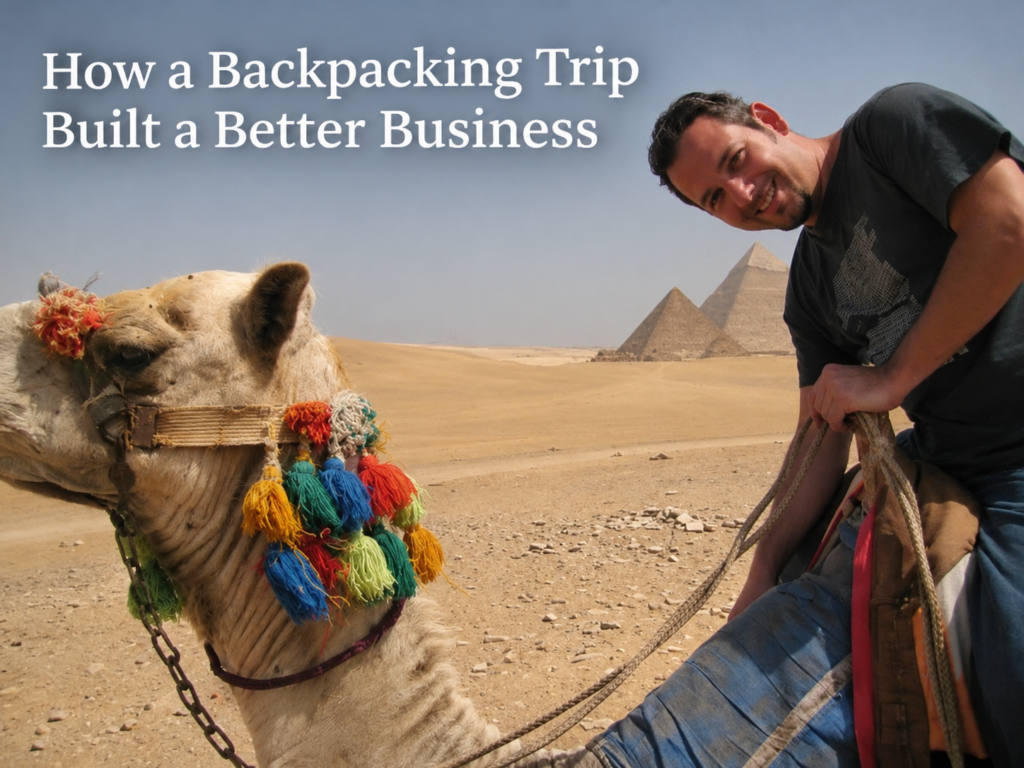
In 2008, four years after founding my first business, Dallas Maids, I decided to do something that most business owners would consider wildly irresponsible. I bought a one-way ticket to Bali, Indonesia, packed a backpack, and set off to travel around the world.
My journey began in Hawaii, where I had the opportunity to meet and speak with members of a secret society. Fascinating conversation, but I can’t tell you much about it. It’s a secret society, after all, and I’d hate to get kicked out of something I was never officially invited to join. From there, I spent a day in Guam before landing in Bali. And that was the extent of my itinerary. No reservations. No carefully planned route. No idea where I’d be sleeping next week. Just a backpack, a passport, and a general commitment to keep heading west until I eventually found my way home.
Bali led to Jakarta, then Singapore, Malaysia, Thailand, Laos, Bahrain, Egypt, Italy, Toronto (where I met may wife), and finally back to Dallas. Along the way, I met fascinating people, experienced extraordinary cultures, made lifelong memories, and gained perspectives that no business seminar or self-help book could ever teach me.
It was an adventure of a lifetime. But believe it or not, the primary reason I traveled around the world wasn’t to see the world. It was to escape my own business. And I mean that in the most productive way possible.
The Best Way to Fix Your Business? Leave It.
By 2008, Dallas Maids had been operating for four years. Business was good, but like so many entrepreneurs, I’d fallen into a familiar trap. I’d built a business that depended far too much on me. Every decision, every little problem, every unexpected hiccup seemed to find its way back to my desk. I’d essentially created a job for myself. Granted, I was the boss, which meant I could give myself a day off whenever I wanted. Unfortunately, my boss was a workaholic who rarely approved vacation requests. Something needed to change.
I knew the solution was to automate my business systems, document our processes, delegate responsibilities, and build an operation that could function without me hovering over everything. The problem? I kept putting it off. There’s always something more urgent when you’re running a business. A customer needs attention. An employee calls in sick. A scheduling problem pops up. Before you know it, another week has disappeared, and you’re still doing everything yourself. So I decided to give myself a deadline that couldn’t be ignored… I was leaving the country for a year.
And if Dallas Maids wanted to survive my little international disappearing act, I’d better figure out how to make it run without me. Nothing motivates an entrepreneur quite like a nonrefundable plane ticket.
Automate the Business. Eliminate the Bottleneck. Especially When the Bottleneck Is You.
I got to work building the systems that would allow Dallas Maids to operate independently. Customer communication, scheduling, quality control, employee management, and all the little processes that keep a cleaning company running had to become repeatable, reliable, and as automated as possible. The goal wasn’t simply to replace paperwork with software. It was to remove unnecessary human error, establish consistent processes, and eliminate the business’s biggest bottleneck.
Me.
After all, humans make mistakes. We forget things. We get distracted. We go on vacation. We occasionaly decide to spend six months wandering through Southeast Asia. Good business systems don’t have those problems.
Of course, people are still essential. A cleaning business without good people is just a collection of mops with an identity crisis. But people perform better when they’re supported by clear processes instead of constantly improvising their way through the day. And an owner performs better when the business doesn’t require their personal involvement in every little decision. That was the freedom I was after.
Six Months Around the World. A Few Bugs Back Home.
My original plan was to travel for an entire year. I made it six months.
As it turns out, my shiny new business systems weren’t quite as bulletproof as I’d imagined. A few things broke down while I was away, forcing me to return to Dallas and fix the problems. Apparently, the business hadn’t gotten the memo that I was supposed to be relaxing somewhere in Italy. But here’s the important part: Those failures were some of the most valuable lessons of the entire trip.
They exposed weaknesses I might never have noticed had I remained in Dallas, quietly putting out fires before anyone else even realized something was burning. When you’re always there to fix problems, you can unknowingly become the very reason those problems never get permanently solved. Removing myself from the equation forced the weaknesses into the open.
So I returned, fixed the bugs, refined the processes, and continued improving the system. It took another couple of years to get everything working the way I wanted. But eventually, something wonderful happened. Dallas Maids could largely run without me. And for the first time since becoming an entrepreneur, I experienced something I’d been chasing all along.
Freedom.
Freedom Is Wonderful. Until You Get Bored.
With most of the day-to-day responsibilities off my plate, I could finally work on the business rather than constantly working in it. That distinction changed everything. Instead of answering every little question and solving every daily problem, I could focus on the bigger picture: improving systems, developing strategies, creating opportunities, and growing the company. And when I wanted to travel, I traveled.
Life was good. Really good. There was just one unexpected problem. I got bored. Turns out, there’s only so much freedom a restless entrepreneur can enjoy before he starts looking around for something else to build. I had discovered that freedom is wonderful, but purpose is just as important. And I needed another purpose. So naturally, I decided to start another cleaning company beecause apparently, my idea of relaxing after building one business was to build another.
The Second Time Around, I Had a Cheat Code
That’s how Emily’s Maids came along but this time, things were different. I wasn’t starting from scratch. I already had years of experience, established operating procedures, proven marketing strategies, and an entire collection of business systems that had been tested, broken, repaired, and improved. The first time around, I’d spent years reinventing the wheel. The second time around, I simply rolled it out of the garage. And it worked.
What had once taken years of trial and error suddenly became much easier. Not effortless, mind you. Starting a business is never entirely effortless. But instead of stumbling through every challenge for the first time, I had a reliable blueprint. And once you have a proven blueprint, something interesting happens. You start wondering where else you can use it.
Along came Memphis Maids. Then Denton Maids. And other cleaning services followed. Each new venture benefited from the lessons learned over the previous two decades. It’s a bit like playing a video game after you’ve already beaten it. You know where the traps are, which shortcuts work, and which decisions lead straight into a pit of hungry alligators. You still have to play the game. You’re just a whole lot better at it.
Why Smart Entrepreneurs Don’t Reinvent the Wheel
This is one of the beautiful things about business systems. Once you’ve invested the time to develop processes that consistently produce excellent results, you can apply them again and again. And it’s precisely why franchising can be so attractive. Consider established cleaning franchises such as Merry Maids, Molly Maid, or MaidThis. When someone buys a franchise, they’re not simply purchasing a name and a fancy logo. They’re purchasing access to a business model, operating procedures, marketing knowledge, training, and experience that someone else has already spent years developing. Essentially, they’re paying to avoid making all the expensive mistakes themselves. Smart move, if you ask me.
Take MaidThis, for example. Neel, the entrepreneur behind MaidThis, has built a business model designed to help franchise owners operate cleaning businesses with established systems and processes. I discuss this in more detail in my article, Why MaidThis Works. It’s a good read, and I recommend checking it out.
Of course, franchising isn’t the only path. You can buy a proven system from someone else, or you can spend years building your own. I chose the latter, mostly because I didn’t realize just how much work I was signing myself up for. But once those systems were established, their value became enormous.
How Denton Maids Hit the Ground Running
When we launched Denton Maids a few years ago, we weren’t entering the Denton market as inexperienced newcomers trying to figure out how to operate a cleaning company. We were bringing roughly two decades of hard-earned experience to the table. We already knew how to recruit and support cleaning professionals, establish quality-control procedures, manage scheduling, communicate with customers, resolve problems, and build lasting customer relationships. We knew which strategies worked. More importantly, we knew which ones didn’t. And believe me, we’d discovered plenty of those the hard way.
Denton Maids benefited from systems refined through years of operating Dallas Maids, Emily’s Maids, and our other cleaning businesses. That meant we could focus on delivering excellent house cleaning services in Denton from the beginning instead of spending years figuring out the basics. We didn’t have to reinvent the wheel. We already had the wheel, the engine, the transmission, and a fairly detailed owner’s manual. All we needed was to put it to work in Denton and that’s exactly what we did.
Why Experience Matters More Than How Long You’ve Been in Town
Some cleaning companies have operated in Denton longer than Denton Maids and that’s perfectly fine, but there’s an important distinction between how long a particular business has existed and how much experience, knowledge, and operational sophistication it brings to the market. A company founded yesterday can benefit from decades of proven systems. Meanwhile, a company that’s been around for twenty years might still be doing everything the same way it did on day one. Longevity matters, but learning, adapting, and improving matter even more. It’s one reason I believe Denton Maids can compete so effectively with companies that have been operating locally much, much longer. We didn’t start with a blank sheet of paper. We started with a playbook that had already survived years of real-world challenges, demanding customers, employee headaches, unexpected disasters, and the occasional owner wandering around Egypt instead of answering his phone.
And that’s our secret. Well, not much of a secret anymore, I suppose.
Your Business Should Give You Freedom, Not a Life Sentence
Over the years, I’ve met countless business owners who are exhausted, overwhelmed, and practically held hostage by the very companies they created. They can’t take a vacation. They can’t unplug for a weekend. Some can’t even enjoy dinner without checking their phones every five minutes. Their businesses own them and that’s a shame.
Entrepreneurship should create opportunity, purpose, financial security, and freedom. Not become a self-imposed prison with slightly better business cards. Yes, building excellent business systems requires an enormous investment of time and effort. Sometimes years but the payoff can be extraordinary. Because once you’ve built an operation that doesn’t depend on your constant involvement, you’re free to focus on growing it, creating new ventures, spending time with family, traveling, or simply enjoying life and if you decide to start another business, those systems can help you build it much faster and more effectively.
That’s the real magic. Not just creating a successful home cleaning business but creating a successful business that doesn’t require you to sacrifice your life to keep it successful.
And That Brings Me Back to My Backpack…
Looking back, that around-the-world adventure in 2008 was one of the best business decisions I ever made. Not because I discovered some revolutionary management philosophy while riding a tuk-tuk through Bangkok. Not because a secret society in Hawaii revealed the ancient mysteries of business automation. Although, come to think of it, that would have made for a much better story. And certainly not because my maid service ran perfectly while I was gone. It didn’t. The trip changed my life because it forced me to confront something many entrepreneurs spend their entire careers avoiding:
If your business can’t survive without you for 6 months, you don’t own a business; you own a job.
That six-month journey taught me to build something bigger than myself. Something that could operate, improve, and grow whether I was sitting in an office in Dallas or wandering through a market halfway around the world and eventually, those same systems helped build Emily’s Maids, Memphis Maids, Denton Maids, and more. All because, back in 2008, I decided to buy a plane ticket and leave. Funny how that works.
I set off to travel around the world, only to discover that the most important thing I brought home wasn’t a souvenir, a photograph, or even a good story. It was a business that could finally go places without me. And that, my friends, is the kind of freedom worth traveling halfway around the world to find.